Open today: 10:00am—4:00pm
free admission
Rhett D'Costa | A Crate full of Mangoes
Rhett D'Costa | A Crate full of Mangoes
Sinclair Gallery
—
Exhibition
The cornerstone of this project, where disparate ideas converge, is the site - 303 Pushpa Bhavan, Colaba, Bombay. The apartment the artist lived in for six years before his family emigrated to Australia. He lost something profound when he left India. Even though he can’t articulate what it is, he feels it deeply. It would be 15 years before he returned to India. And to the apartment which was becoming more significant in his life as time passed. On this occasion and subsequent trips back to India, he looked for answers to unasked questions. Trying to reclaim the thing that was lost.
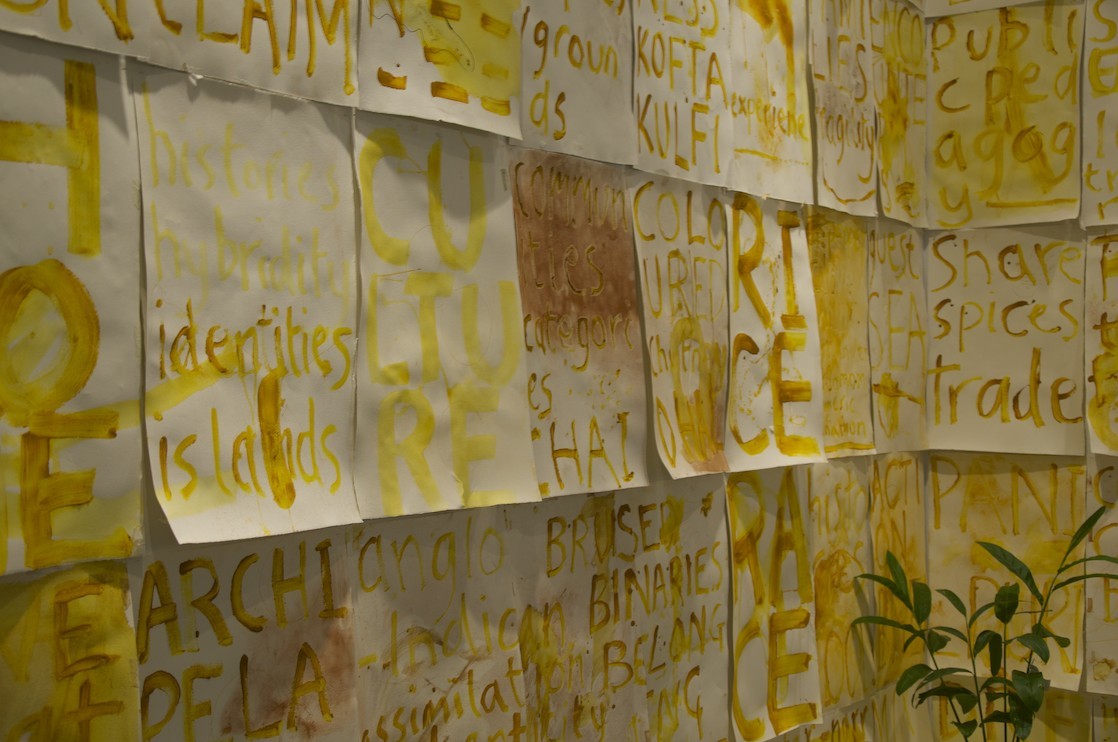
A Crate Full of Mangoes employs an experimental methodology in exhibition making, as a way to generate meaning and knowledge. Memory, lived experience, and storytelling become central in this process. Utilizing text-based artworks, short stories, objects, ready-mades, video, performance and photography, the exhibition highlights the artist’s ongoing investigations around his mixed-race identity, and entangled sense of place which gives rise to complex ideas of home and belonging.
[...] exiles or emigrants or expatriates, are haunted by some sense of loss, some urge to reclaim, to look back, even at the risk of being mutated into pillars of salt. But if we do look back, we must also do so in the knowledge – which gives rise to profound uncertainties – that our physical alienation from India almost inevitably means that we will not be capable of reclaiming precisely the thing that was lost; that we will, in short, create fictions, not actual cities or villages, but invisible ones, imaginary homelands, India’s of the mind.
Salman Rushdie
Bio:
Rhett D’Costa was born in India and immigrated to Australia as a child with his family. While his experiences as an Asian Australian informs his pan disciplinary art practice and research, from the formal and expressive use of colour to complex expressions of identity and belonging, it is his ongoing commitment to painting which underpins and informs everything else, including the fluid nexus between art, food and the garden. His collaborative work has extended his art practice to engage experientially and experimentally with the environment he currently lives and works in Dja Dja Wurrung lands.
In a career spanning thirty years in art practice and tertiary art education, his particular focus has centred around the Asia-Pacific region. He has exhibited in numerous solo and group exhibitions nationally and internationally and his work in held in institutional, public, and private collections. He is an Honorary University Fellow of RMIT University.
Caption
Rhett D'Costa Opening Up the Anglo-Indian Tiffin (Detail) from the exhibition, 'Bruised Food: a living laboratory' RMIT Gallery 2019. Image courtesy of the artist.
To read the accompanying exhibition text - A Crate Full of Mangoes - 11 Stories
2:00pm
—
3:00pm
Rhett D’Costa in conversation with writer Deborah Ratliff
2:00pm
—
3:00pm
Starstruck - A Performance by Rhett D'Costa
Download 11 Stories
The cornerstone of this project, where disparate ideas converge, is the site - 303 Pushpa Bhavan, Colaba, Bombay. The apartment the artist lived in for six years before his family emigrated to Australia. He lost something profound when he left India. Even though he can’t articulate what it is, he feels it deeply. It would be 15 years before he returned to India. And to the apartment which was becoming more significant in his life as time passed. On this occasion and subsequent trips back to India, he looked for answers to unasked questions. Trying to reclaim the thing that was lost.
A Crate Full of Mangoes employs an experimental methodology in exhibition making, as a way to generate meaning and knowledge. Memory, lived experience, and storytelling become central in this process. Utilizing text-based artworks, short stories, objects, ready-mades, video, performance and photography, the exhibition highlights the artist’s ongoing investigations around his mixed-race identity, and entangled sense of place which gives rise to complex ideas of home and belonging.
[...] exiles or emigrants or expatriates, are haunted by some sense of loss, some urge to reclaim, to look back, even at the risk of being mutated into pillars of salt. But if we do look back, we must also do so in the knowledge – which gives rise to profound uncertainties – that our physical alienation from India almost inevitably means that we will not be capable of reclaiming precisely the thing that was lost; that we will, in short, create fictions, not actual cities or villages, but invisible ones, imaginary homelands, India’s of the mind.
Salman Rushdie
Bio:
Rhett D’Costa was born in India and immigrated to Australia as a child with his family. While his experiences as an Asian Australian informs his pan disciplinary art practice and research, from the formal and expressive use of colour to complex expressions of identity and belonging, it is his ongoing commitment to painting which underpins and informs everything else, including the fluid nexus between art, food and the garden. His collaborative work has extended his art practice to engage experientially and experimentally with the environment he currently lives and works in Dja Dja Wurrung lands.
In a career spanning thirty years in art practice and tertiary art education, his particular focus has centred around the Asia-Pacific region. He has exhibited in numerous solo and group exhibitions nationally and internationally and his work in held in institutional, public, and private collections. He is an Honorary University Fellow of RMIT University.
Caption
Rhett D'Costa Opening Up the Anglo-Indian Tiffin (Detail) from the exhibition, 'Bruised Food: a living laboratory' RMIT Gallery 2019. Image courtesy of the artist.
To read the accompanying exhibition text - A Crate Full of Mangoes - 11 Stories
Download 11 Stories
2:00pm
—
3:00pm
Rhett D’Costa in conversation with writer Deborah Ratliff
2:00pm
—
3:00pm
Rhett D’Costa in conversation with writer Deborah Ratliff
2:00pm
—
3:00pm
Rhett D’Costa in conversation with writer Deborah Ratliff
2:00pm
—
3:00pm
Starstruck - A Performance by Rhett D'Costa
2:00pm
—
3:00pm
Starstruck - A Performance by Rhett D'Costa
2:00pm
—
3:00pm
Starstruck - A Performance by Rhett D'Costa
More Exhibitions
More Exhibitions



Castlemaine Art Museum acknowledges the traditional custodians of the land on which the Gallery stands, the Jaara people of the Dja Dja Wurrung nation, and recognise their continuing connection to the land and waterways.
Copyright © 2026 Castlemaine Art Museum
14 Lyttleton Street (PO Box 248)
Castlemaine VIC 3450
Opening Hours
FREE ENTRY ALWAYS
Thursday—Friday 10:00AM–4:00PM
Saturday 11:00am–4:00PM
Sunday 12:00pm–4:00pm
supported by





Castlemaine Art Museum acknowledges the traditional custodians of the land on which the Gallery stands, the Jaara people of the Dja Dja Wurrung nation, and recognise their continuing connection to the land and waterways.
Opening Hours
FREE ENTRY ALWAYS
Thursday—Friday 10:00AM–04:00PM
Saturday 11:00am–04:00PM
Sunday 12:00pm–04:00pm
About
supported by


Castlemaine Art Museum acknowledges the traditional custodians of the land on which the Gallery stands, the Jaara people of the Dja Dja Wurrung nation, and recognise their continuing connection to the land and waterways.
Opening Hours
FREE ENTRY ALWAYS
Thursday—Friday 10:00AM–04:00PM
Saturday 11:00am–04:00PM
Sunday 12:00pm–04:00pm
About
supported by
supported by
Castlemaine Art Museum acknowledges the traditional custodians of the land on which the Gallery stands, the Jaara people of the Dja Dja Wurrung nation, and recognise their continuing connection to the land and waterways.
Opening Hours
FREE ENTRY ALWAYS
Thursday—Friday 10:00AM–04:00PM
Saturday 11:00am–04:00PM
Sunday 12:00pm–04:00pm
supported by
Castlemaine Art Museum acknowledges the traditional custodians of the land on which the Gallery stands, the Jaara people of the Dja Dja Wurrung nation, and recognise their continuing connection to the land and waterways.
Opening Hours
FREE ENTRY ALWAYS
Thursday—Friday 10:00AM–04:00PM
Saturday 11:00am–04:00PM
Sunday 12:00pm–04:00pm
About
supported by